
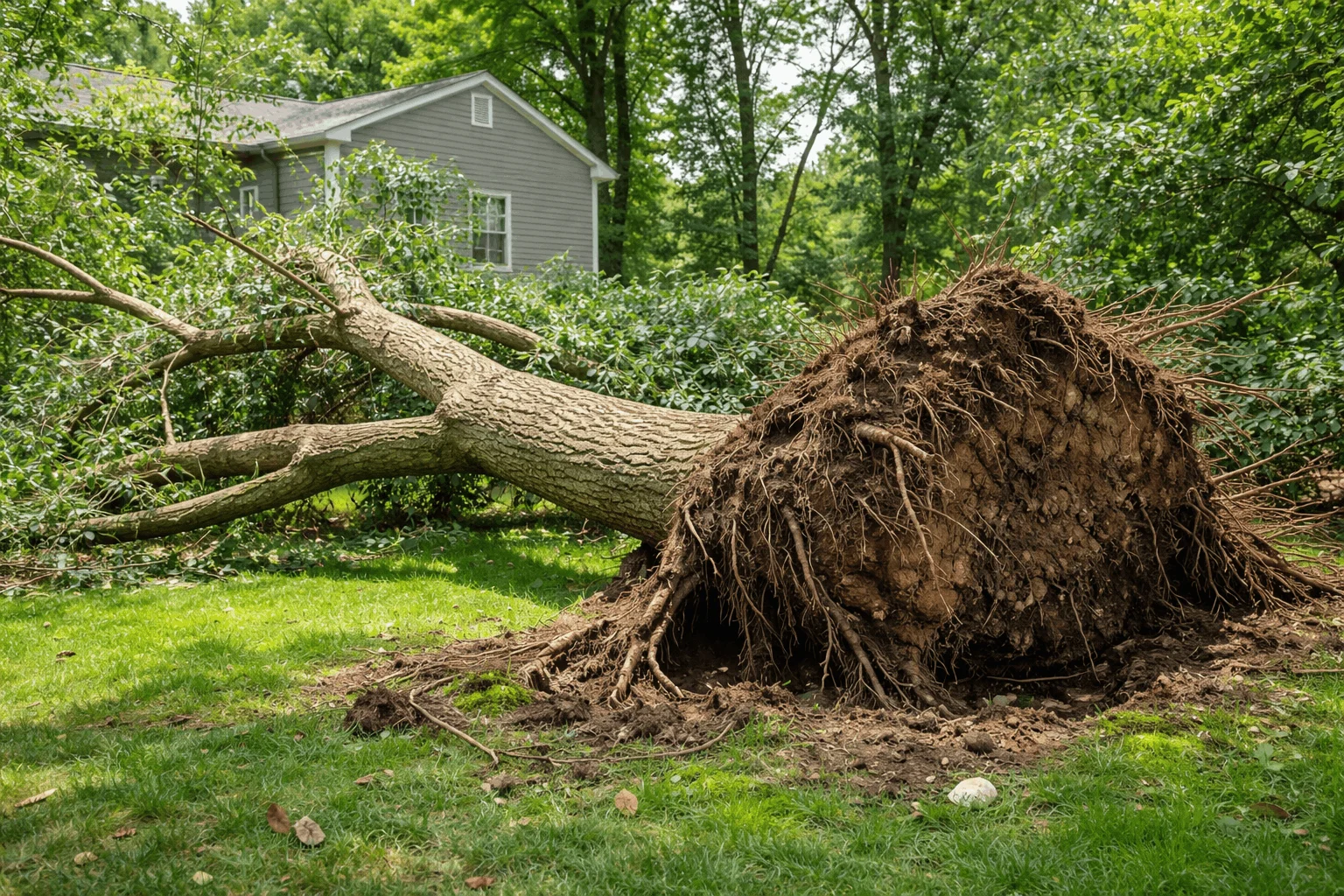
When a tree gets uprooted, it usually looks bad right away. The trunk is down, the roots are exposed, and the ground around it can look torn apart. But with this kind of tree failure, the bigger concern is not always just the part you can see.
An uprooted tree can affect the soil, the way the trunk is resting, and what is happening below ground near the root area. Even though the tree is no longer standing, that does not mean it is stable or simple to remove. In many cases, the trunk is still holding pressure, the root ball is still partly attached, and the ground around the base is loose.
That is why uprooted tree removal is handled differently from a normal removal. Some situations need fast attention, especially if the tree is on a house, blocking access, near utility lines, or sitting in a way that looks like it could shift again. Tree On Me provides 24-hour emergency response across Montgomery County for urgent situations.
What Causes Trees to Uproot
Most trees do not uproot because of one single issue. Usually, a few things build up over time, then weather or ground movement pushes the tree past its limit.
Common causes include:
- Root rot that weakens the tree below ground
- Shallow root systems that do not anchor deeply
- Saturated soil after long or heavy rain
- Strong wind loading against the canopy
- Construction damage around the root zone
A tree can also look fine from above and still have a weakened support system underneath. That is what makes uprooting tricky for homeowners. The failure may feel sudden, but the weakness may have been developing for quite a while.
Wet ground is one of the most common factors. Once the soil gets soft, it can lose some of its grip around the roots. Then wind comes in, pushes against the crown, and the whole tree may begin to lean, lift, or fall over completely. That is why many homeowners first notice a tree uprooted after a storm.
If the tree came down during severe weather, Tree On Me’s storm damage tree removal page is also relevant, since storm-related tree failures often involve more than one risk at the same time.
Hazards You May Not See
The obvious damage is only part of the issue. Uprooted trees can create hidden problems that are easy to miss from the driveway or sidewalk.
Underground utility disruption
When a large root mass pulls out of the ground, it can disturb the soil around buried lines. That does not automatically mean a utility line is damaged, but it does mean the area should be treated carefully. If roots were disturbed near utility lines, contact the appropriate utility company directly.
Unstable root ball
The root ball may still be attached and carrying part of the tree’s weight. That can make it behave like a hinge or pivot point. It may look still, then move once the trunk is cut or weight comes off another section.
Soil collapse around the void
When the roots lift out, they leave behind a hole or weakened area in the ground. That space can stay soft, crumble at the edges, or collect water. So even after the tree is removed, the area may still need to be handled carefully.
Gas line proximity
If the uprooted area is near a meter, service line, or known utility route, it is best not to guess. If there are signs of damage or anything unusual near utility components, contact the appropriate utility company.
Why Uprooted Tree Removal Is Different
A standard tree removal starts with a standing tree. The weight is easier to read, and the cutting sequence is built around that. An uprooted tree is different because the center of gravity has already shifted.
That changes the whole job.
What makes it different:
- The trunk may be resting under uneven pressure
- Certain sections may be twisted, pinned, or loaded
- Standard cutting order may no longer apply
- The root ball often has to be managed separately
That is the part many homeowners do not realize. A tree on the ground is not always safer or easier to deal with. In some cases, it is actually less predictable because the failure has already happened and the tree is now sitting in an unstable position.
The base matters too. If the root plate is still partly upright or partly attached, removing the wrong section too early can change how the entire tree moves. On larger or tighter jobs, crane-assisted removal for complex jobs may be part of the plan when extra control is needed.
The Removal Process
Every uprooted tree is a little different, but the process usually follows the same general pattern.
1. Site assessment
The first step is figuring out how the tree failed and how it is resting. The crew looks at the trunk, the root ball, the ground around the void, nearby structures, and whether utilities may be involved.
2. Stabilizing the root ball
If the root mass is still attached and unstable, it may need to be managed before cutting begins. This helps reduce the chance of sudden movement once weight starts coming off the tree.
3. Sectioning the trunk and limbs
The tree is usually removed in pieces, with the cutting order based on where pressure and weight are sitting. With an uprooted tree, this part matters a lot because the wrong first cut can shift the entire setup.
4. Managing the root void
Once the main sections are removed, the ground may still need attention. The hole left behind can remain loose or uneven, especially after a storm or major soil movement. If digging is needed around that area, call 811 first before excavation planning begins.
5. Clearing debris
The final step is cleanup. That can include hauling away wood, removing limbs, and leaving the site in a more workable condition for any next steps on the property.
Serving Montgomery County
Tree On Me provides uprooted tree removal across Montgomery County, MD. That includes trees uprooted by storms, root failure, saturated soil, and similar structural failures on or near residential properties.
No two properties are exactly alike. Some have narrow access, some have slopes, and some have nearby fences, driveways, garages, or homes that affect how the removal should be approached. That is why the plan has to match the actual setup, not just the fact that the tree is down.
Tree On Me serves homeowners dealing with:
- Trees uprooted after storms
- Fallen uprooted trees near homes or driveways
- Exposed root balls and soil displacement
- Trees affecting access or nearby structures
- Complex removals that may require added control
If you are dealing with an uprooted tree on your property in Montgomery County, Tree On Me can assess the condition of the tree, the surrounding ground, and the safest way to remove it.