
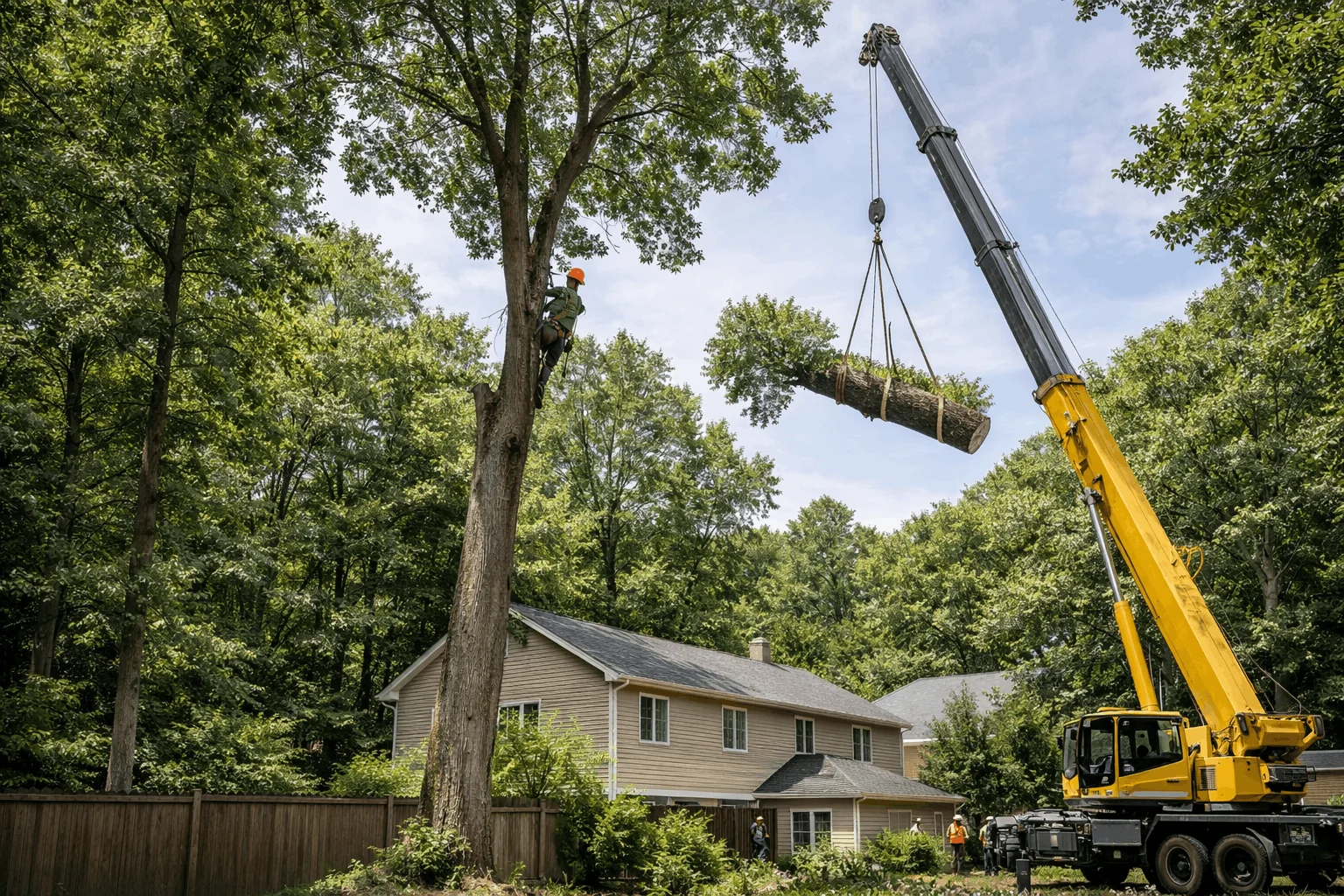
Most tree removals do not require a crane. Many can be handled with climbing, rigging, and a careful cut-and-lower process. But some trees are positioned in a way that makes standard removal less practical. They may be over a house, leaning onto a garage, boxed in by nearby structures, or located where there is no safe area to lower large pieces.
That is when crane-assisted tree removal may be the better approach. It is not used on every job, and it is not there for show. It is a specialized method for situations where lifting sections of a tree in a controlled way makes more sense than relying on standard felling or repeated rope-lowering alone.
On properties across Montgomery County, this often comes up when mature trees are close to homes, garages, patios, driveways, or neighboring lots. It can also apply in situations similar to roof tree removal, tree on garage removal, or a tree on house removal service. In each case, the main issue is not just tree size. It is how the tree can be removed with the right level of control for the space around it.
What Is Crane-Assisted Tree Removal
Crane-assisted tree removal is a method where selected parts of a tree are cut and lifted by crane instead of being lowered only by ropes or dropped into an open landing zone. The crane supports the piece while it is being removed, then moves it to a designated spot on the ground.
How it differs from a standard removal
In a standard tree removal, an arborist may climb the tree, attach rigging, cut limbs or trunk sections, and lower them using ropes, blocks, and friction devices. On some jobs, a block-and-tackle setup or other mechanical-advantage system helps move or control wood in tighter spaces. That works well on many properties.
Crane-assisted removal is different because the crane becomes part of the load-control system. Instead of asking the tree, ropes, and ground crew to manage all of the force from a heavy section, the crane can support that weight directly.
How crane rigging works on tree jobs
The exact setup depends on the tree and the site, but the general process usually includes:
- attaching slings to the section being removed
- connecting the slings to the crane line
- applying light tension before the cut
- making the cut once the load is supported
- lifting and moving the piece to a landing area
The point is not to remove the whole tree in one dramatic lift. It is to remove the tree in sections that can be controlled more precisely.
When a Crane Is the Right Tool
A crane is not needed just because a tree is big. Some large trees can still be removed safely with standard rigging if there is room to work and the structure of the tree allows it. On the other hand, even a medium-sized tree may call for a crane if the location is tight or the targets below make standard removal less ideal.
A crane may be the right tool when:
- the tree is over a house, garage, deck, or other structure
- there is no safe felling zone
- nearby landscaping or hardscape leaves very little room for swing or drop
- the tree is close to utility areas or other sensitive targets
- some sections are too heavy or awkward for practical manual lowering
- conventional rigging would place too much stress on a compromised tree
A crane may be optional when:
- access is open and the crew has room to work
- the tree can be dismantled safely in smaller sections
- there is enough space for normal rigging and lowering
- the remaining structure of the tree is sound enough for standard rigging loads
Why this matters
The decision is really about control. If the safest and cleanest removal plan involves lifting sections out instead of cutting and lowering them piece by piece, crane assistance may be the better fit. If standard rigging can handle the job well, a crane may not be necessary.
The Crane Removal Process Step by Step
Every crane-assisted removal starts with planning. The crew first looks at the tree, the targets around it, the access points, and the ground conditions. They also consider lean, structural defects, decay, crack patterns, and how the tree is loading nearby structures.
1. Site assessment
Before any lifting begins, the site needs to be evaluated carefully. This includes:
- the tree’s size, condition, and balance
- where the weight is sitting
- what is below or beside the tree
- where the crane can be positioned
- where removed pieces can be landed
2. Crane positioning
The crane must be set in a location that gives it the right reach and angle for the job. Sometimes that is from the street. Sometimes it is from a driveway or another stable surface. Positioning matters because the working radius affects how the lift can be performed.
3. Rigging attachment
Once the removal sequence is planned, slings are attached to the section that will be lifted. The crane line is connected, and the piece is lightly tensioned before the cut. Depending on the job, taglines may also be used to help control rotation.
4. Lift-and-lower sequence
The cut is made only after the section is supported. The crane then lifts the piece free and moves it to a landing zone, where the ground crew detaches it and processes it. This sequence is repeated until the tree is dismantled.
5. Ground crew coordination
The crane does not replace the crew. It works with the crew. The climber or lift operator, crane operator, and ground team all need to stay coordinated throughout the job. Each pick changes the balance of the tree, so communication matters from start to finish.
Safety Advantages of Crane Removal
Crane-assisted removal can offer real safety advantages in the right situation. That does not mean it is automatically the safest option on every job. It means that in certain layouts, it allows for a more controlled removal than standard methods alone.
More controlled movement
One of the biggest advantages is controlled handling of heavy sections. Instead of cutting a section and relying only on ropes and rigging points to manage the movement, the crane can support the load as it separates. That can reduce uncontrolled swinging, bouncing, or hard catches.
Less reliance on directional felling
If a property has very little open space, directional felling may not be the most suitable method. Removing the tree in lifted sections can be a better match for sites where there is not enough room for a full lay or for large rope-lowered pieces.
Reduced impact on structures and landscaping
When pieces can be lifted clear and moved to a designated landing zone, there may be less dragging across the lawn and less repeated movement over roofs, patios, fences, or planting areas. On tighter residential lots, that extra control can make a noticeable difference.
Better fit for high-complexity jobs
Crane-assisted work is especially useful when the issue is not just tree removal, but tree removal around something important. That may be a house, a garage, a retaining wall, or another structure that leaves very little margin for error.
Crane-Assisted Removal in Montgomery County
Tree On Me provides tree services across Montgomery County, MD, including jobs where crane-assisted removal may be appropriate. On local properties with mature trees, tighter setbacks, and limited drop zones, some removals require a more specialized plan than standard cutting and lowering alone.
Where this type of work commonly comes up
Crane-assisted removal may be considered on properties in areas such as:
- Rockville
- Bethesda
- Silver Spring
- Gaithersburg
- Potomac
- Germantown
- Wheaton
- Kensington
These communities often include established lots where large trees are close to homes, garages, driveways, and neighboring structures. In those situations, the method used matters just as much as the tree itself.
Tree On Me’s approach
Tree On Me evaluates each site based on the actual layout, tree condition, and removal challenges involved. Some trees can be handled with conventional rigging. Others may call for crane-assisted removal because of structure contact, limited access, restricted felling space, or the size and position of the wood being removed.
The goal is to choose the method that fits the site, not to force the same process onto every job. In more complex cases, crane-assisted removal can be the more controlled option for dismantling a tree safely and efficiently within the limits of the property.