
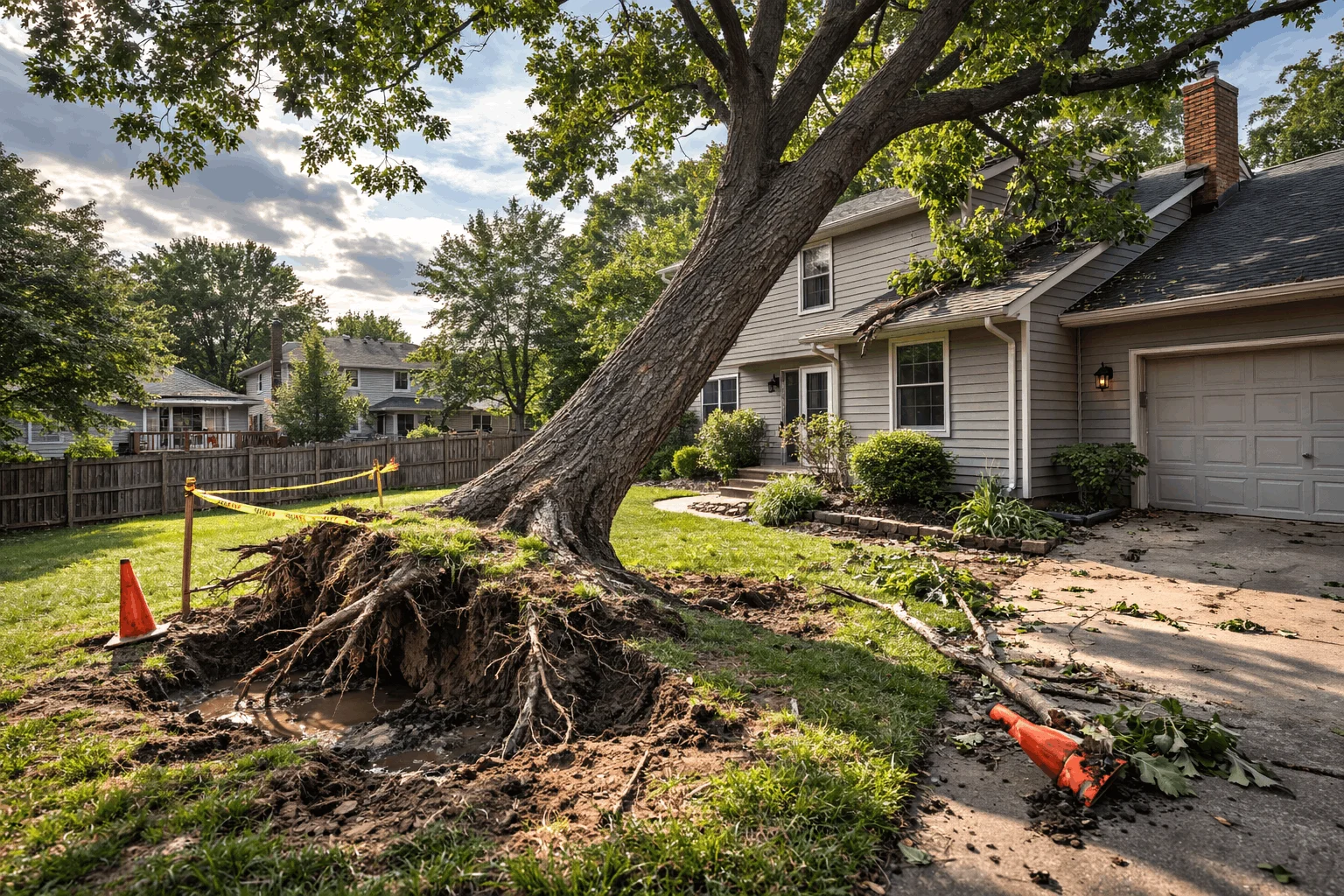
A leaning tree is the kind of thing that makes you stop and look twice, especially when it seems to be leaning toward your house, garage, fence, or driveway. Most people are not going to feel great about that, and honestly, that is understandable.
At the same time, not every leaning tree is a serious problem. Some trees have grown that way for years and stayed more or less the same. Others start shifting after heavy rain, wind, soft ground, or root trouble. That is when people start wondering whether they are looking at something normal or something that needs attention.
That is really the bigger question. Not just, “Is the tree leaning?” but “Has it always looked like that?” “Did it change recently?” “What is happening at the base?” and “What is it going to hit if it moves more?” Tree On Me provides leaning tree removal service in Montgomery County for homeowners who want a straightforward assessment and a safe plan when a tree no longer feels stable.
Not All Leaning Trees Are Equal
A lot of homeowners see a leaning tree and immediately think it has to come down. Sometimes that ends up being true. Other times, not necessarily. Trees do not all lean for the same reason. Some grow at an angle because they are chasing sunlight, adjusting around nearby trees, or growing on sloped ground. If the lean has been there for a long time and the tree still looks solid overall, it may not be showing signs of active failure.
What gets people’s attention more is a lean that seems new. Maybe the tree used to look fairly upright, and now it just looks off after a storm or after several days of wet weather. That can point to a support issue, especially if the tree is leaning toward a structure instead of into open yard space. And usually, the base tells you more than the top. Lifted soil, shifting roots, or changes around the root flare can say a lot. A tree can still look green and alive from across the yard and still be less secure than it seems. If you have also noticed any of the signs a tree is dangerous, it is probably worth getting it looked at before the lean gets worse.
Risk Factors That Escalate a Leaning Tree to a Hazard
A leaning tree becomes harder to ignore when other warning signs start showing up with it. Usually it is not one huge, obvious thing. More often, it is a few smaller details that start adding up.
Common warning signs to pay attention to
- Exposed roots or lifting soil around the base
- Fresh soil heave on one side of the trunk
- Leaning toward a house, garage, fence, or other structure
- A dead or thinning crown
- Cracks, wounds, or bark damage near the base
- A recent change in angle after wind or saturated ground
Root exposure matters because the roots are what keep the tree anchored. If they are starting to lift, or the ground around the base looks pushed up, the tree may already be shifting. This can become more noticeable after a long wet stretch, when the soil is softer and not holding the root system the way it normally does.
The direction of the lean matters too. A tree leaning into open yard space may still need removal, but it is a very different situation when it is leaning toward a roofline, porch, fence, or another part of the property. It does not need to be touching anything yet to be a concern. Sometimes the issue is simply that there is not much room for error left.
Then there is the condition of the tree itself. A dead crown, visible dieback, or bark damage near the lower trunk can suggest the tree is stressed or weakened where it needs to be strongest. That does not automatically mean it is about to fail, but it does make the lean harder to dismiss. A dangerous leaning tree does not always look dramatic. Sometimes it just looks a little different than it did before, and that small difference ends up mattering more than expected.
The Assessment Process
When Tree On Me looks at a leaning tree, the goal is to figure out whether the tree still seems stable or whether removal is the safer move. It usually starts with a visual inspection. That includes the angle of the lean, the trunk shape, the crown condition, branch weight, and any visible cracks or signs the tree has shifted recently. A tree that has leaned naturally for years tends to look different from one that changed position after a storm or a stretch of wet ground.
After that, the focus moves to the root zone and the space around the tree. Soil lifting, cracking, exposed roots, or movement near the base can point to a support issue even when the upper part of the tree still looks fairly sound. Tree On Me also looks at what the tree could reach if it leans farther, whether that is a house, driveway, deck, or nearby property, along with how much room there is to work safely. If you are not sure whether the tree is just concerning or has turned into a real hazard, a hazardous tree assessment can help make that clearer.
How Leaning Trees Are Removed
There is no one standard method for leaning tree removal. The safest approach depends on the tree, how much it is leaning, what the roots are doing, what it is leaning toward, and how much working space the property gives.
Directional felling
If there is enough open space and the tree’s condition allows for it, directional felling may be the best option. That means the cuts are planned so the tree can be guided into a controlled landing area. With a leaning tree, that takes extra care because the weight is already pulling to one side. The crew has to work with that pull instead of trying to force the tree somewhere it does not want to go.
Rope systems and controlled lowering
If the tree is close to a structure or there is not enough room to drop it in one piece, it may need to come down section by section. In those cases, rope systems are used to support and lower branches or trunk sections in a controlled way. That helps limit sudden movement and cuts down the chance of impact in a tighter work area.
Crane-assisted removal
Sometimes directional felling is just not the right fit. If the tree is leaning over a house, access is limited, or the tree is too unstable to remove safely from the ground, crane use may make more sense. A crane can lift sections up and away from the structure rather than trying to bring everything down through a narrow space below.
This is usually the point where the difference between small yard cleanup and actual removal becomes pretty obvious. Some homeowners may clear a small limb from open ground themselves, and that is understandable. But a larger leaning tree is a completely different situation. Once you add height, trunk weight, unstable roots, nearby structures, or built-up tension in the wood, the work calls for professional equipment and a controlled plan. Even a cut that looks simple from the ground can change the balance of the tree in ways that are hard to predict without proper rigging and experience. And when it becomes a tree leaning on house removal situation, there is even less room for error. That is especially true with any tree leaning toward structure where there is very little space to work with.
If the lean is connected to storm damage or the situation needs faster attention, Tree On Me also offers emergency tree service in Montgomery County.
Serving Montgomery County
Tree On Me serves homeowners throughout Montgomery County, MD. That local focus matters because properties across the county are not all the same. Some have older, mature trees close to the house. Others have sloped yards, fenced backyards, narrow access, or limited room for equipment. Those details can change how a tree is assessed and how removal is handled.
If you are looking at a tree that seems to be shifting, leaning toward a structure, or showing movement around the base, it is worth getting a professional opinion before deciding to leave it alone. Not every leaning tree needs to come down. But when the lean is new, the root zone is moving, or the tree is aimed at something important, removal may be the safer option.
To request an evaluation in Montgomery County, contact Tree On Me through the website and describe what you are seeing, including whether the lean seems recent, whether roots are lifting, and what is in the tree’s path.