
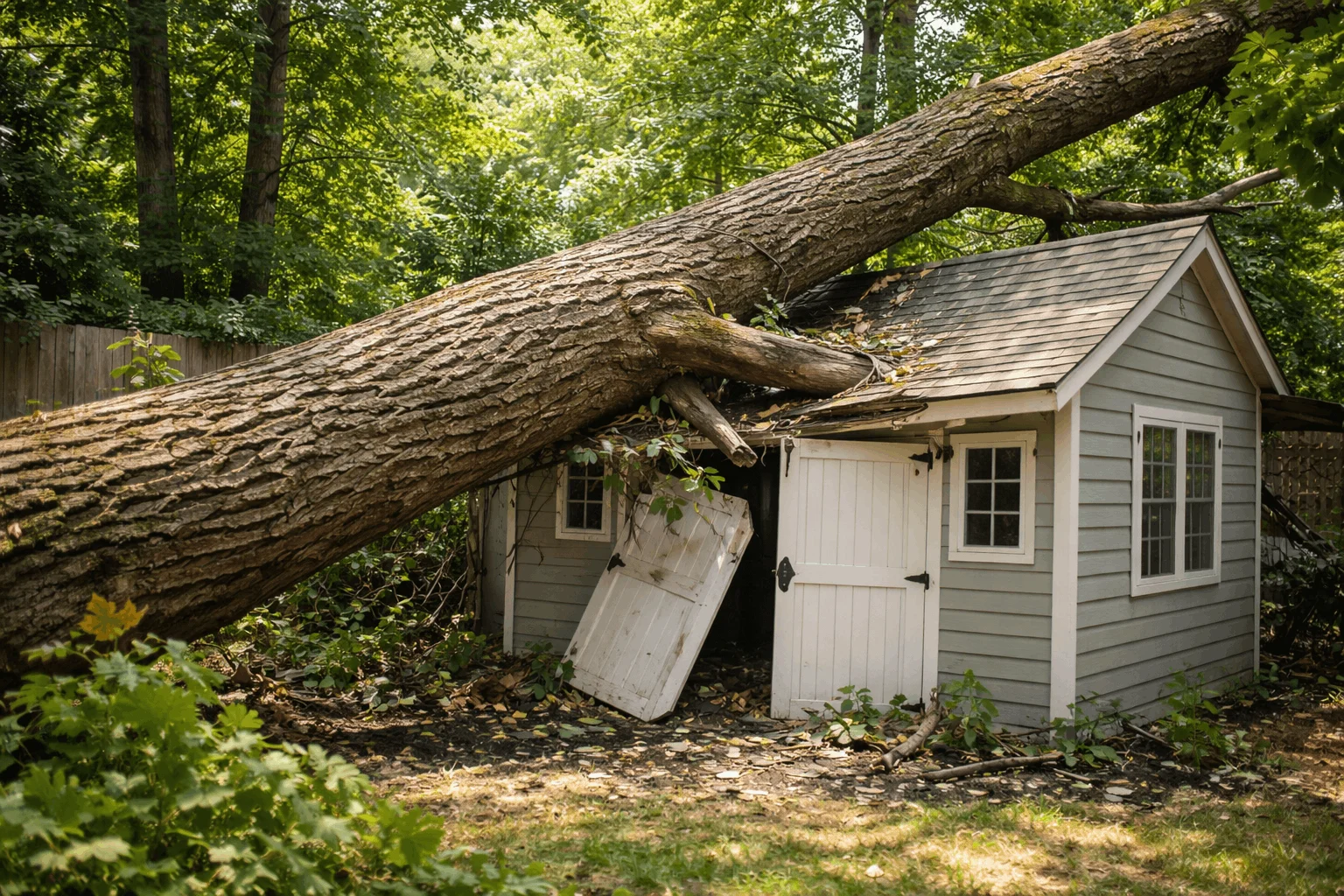
When a tree falls on a shed, pool house, workshop, or other outbuilding, most homeowners have the same first thought: is this a big problem, or just a smaller version of a tree on a house?
Usually, it is not that simple.
A shed or other backyard structure may be smaller than a house, but that does not always make the situation easier. In a lot of cases, these structures are lighter, less reinforced, and more likely to shift once weight is added to the roof or wall. A tree that might sit on a stronger structure for a while can cause a shed or pool house to sag, rack, or partially collapse much faster.
That is why tree on shed removal needs its own approach. The tree still has to come off carefully, but the structure underneath often gives crews less stability to work with. Access can also be tighter, especially in fenced backyards or around patios, pools, landscaping, and neighboring property lines.
Tree on a Shed: Is It an Emergency?
Sometimes yes, sometimes no.
A tree on an unoccupied shed is not always handled the same way as a tree on a main residence. But that does not mean it should be treated casually either. Smaller structures can fail faster under load, especially if the roof is lightly framed or the impact pushed the walls out of square.
It helps to think about the question in layers.
When it may need faster attention
A tree on a shed can move into urgent territory when:
- the structure is actively collapsing or shifting
- electrical wiring runs to the shed or through the impact area
- the tree is affecting a nearby fence, pool equipment, or another structure
- tools, fuel, lawn equipment, or other stored items create added hazards
- the tree is tangled with utility lines or blocking a safe path around the yard
If the situation also involves an occupied structure, blocked exits, or utility concerns, Tree On Me also offers 24-hour emergency service service.
When it may be less immediate
Some cases are more contained. For example, a smaller limb across the roof of a detached shed with no power, no active collapse, and no nearby hazards may not rise to the same level as a tree on a home.
But even then, it still needs a proper assessment. What looks minor from the yard can be hiding split rafters, wall movement, or pressure points that change once the tree is cut.
So the better question is not just, “Is it an emergency?” It is, “How stable is the structure right now, and what happens when the weight changes?”
Why Outbuilding Removal Has Its Own Challenges
A shed, pool house, workshop, or carport is different from both a house and a garage.
A house usually has a more substantial structural system. A garage often has its own removal concerns because of wide openings and open interior spans. Tree On Me covers that separately on its tree on garage removal page.
Outbuildings are often lighter than either one.
Less structure to work against
That matters a lot during removal. With a house, there may be more framing, interior walls, and stronger roof systems helping hold shape during the process. A shed or pool house may not have that margin. Once a tree lands on it, the building can become unstable in a way that changes with every cut.
In plain terms, crews are not just removing wood. They are managing how the structure underneath reacts while the load comes off.
Tight backyard access
Outbuilding jobs also tend to happen farther back on the property. That can mean:
- narrow gates
- fences on both sides
- limited room for equipment
- patios, gardens, and hardscaping nearby
- less space for staging debris
That backyard layout affects everything from where crews stand to how sections are lowered and carried out. The job may look smaller than a front-yard removal, but in some ways it can be more technical because there is less room for error.
The Removal Approach
No two tree-on-shed jobs look exactly the same, but the general approach starts with the same priority: understand the load before starting to cut.
First, assess the tree and the structure together
The tree cannot be evaluated in isolation. Crews need to look at where the weight is sitting, whether the roof has already dropped, whether walls are leaning, and whether the structure is stable enough to work around.
They also need to check the surroundings. A detached workshop may have power. A pool house may have nearby utilities or equipment. A carport may be tied into a fence line or paved area. Those details change the removal plan.
Hand cutting for smaller, controlled removals
If the tree or limb is manageable in size and the site is tight, removal may be done with careful hand cutting and controlled piece-by-piece reduction. That can make sense when the goal is to reduce weight gradually without introducing a sudden shift.
This kind of work is especially common in compact backyards where large equipment access is limited.
Crane use for larger or heavier sections
If the tree is larger, heavier, or positioned in a way that makes manual breakdown less controlled, crane-assisted removal may be the safer option. A crane can lift sections more directly instead of dragging or rolling weight across an already weakened structure.
Whether that is necessary depends on tree size, access, layout, and how the load is sitting at the time of assessment. It is not the answer on every job, but it is part of the decision-making when the tree is too large or the structure is too fragile for a slower ground-based breakdown.
Debris management in confined spaces
Backyard debris handling is part of the job too. On a shed or pool house removal, there is often less room to stack material, move brush, or position equipment. That means cleanup and removal have to be planned right along with the cutting process, not treated as an afterthought.
What Happens to the Structure
This is where homeowners usually want a clear answer: can the shed be saved?
Sometimes yes. Sometimes no. But that answer usually becomes clearer only after the tree is off.
A tree can make damage look worse than it is, or it can hide how much the framing has shifted. Once the load is removed, a contractor can better evaluate whether the shed, pool house, or other outbuilding can be repaired, reinforced, or rebuilt.
That distinction matters.
Tree On Me’s scope is the tree removal and site clearing side of the job. The structural evaluation comes after that and is a separate step handled by the appropriate contractor. The same idea applies when the damage involves the main residence rather than a backyard structure. For those cases, Tree On Me also provides tree on house removal.
So if you are looking at a damaged shed and wondering whether anyone can promise it will be saved before the tree is removed, the honest answer is no. The structure needs to be seen clearly once the weight is off.
Serving Montgomery County
Tree On Me serves Montgomery County, MD, with a local service focus that includes common communities such as Rockville, Bethesda, Silver Spring, Gaithersburg, Potomac, Germantown, Wheaton, and Kensington. That local focus matters on outbuilding jobs because backyard access, lot layout, tree size, and neighborhood spacing can vary a lot across the county.
Whether the issue involves a shed behind the house, a pool house near a patio, a workshop tucked into a fenced yard, or another detached structure, the removal plan needs to match the actual structure and site conditions, not just the fact that a tree came down.
A tree on a shed may sound like a smaller problem than a tree on a house. In real life, it is often just a different kind of technical job.