
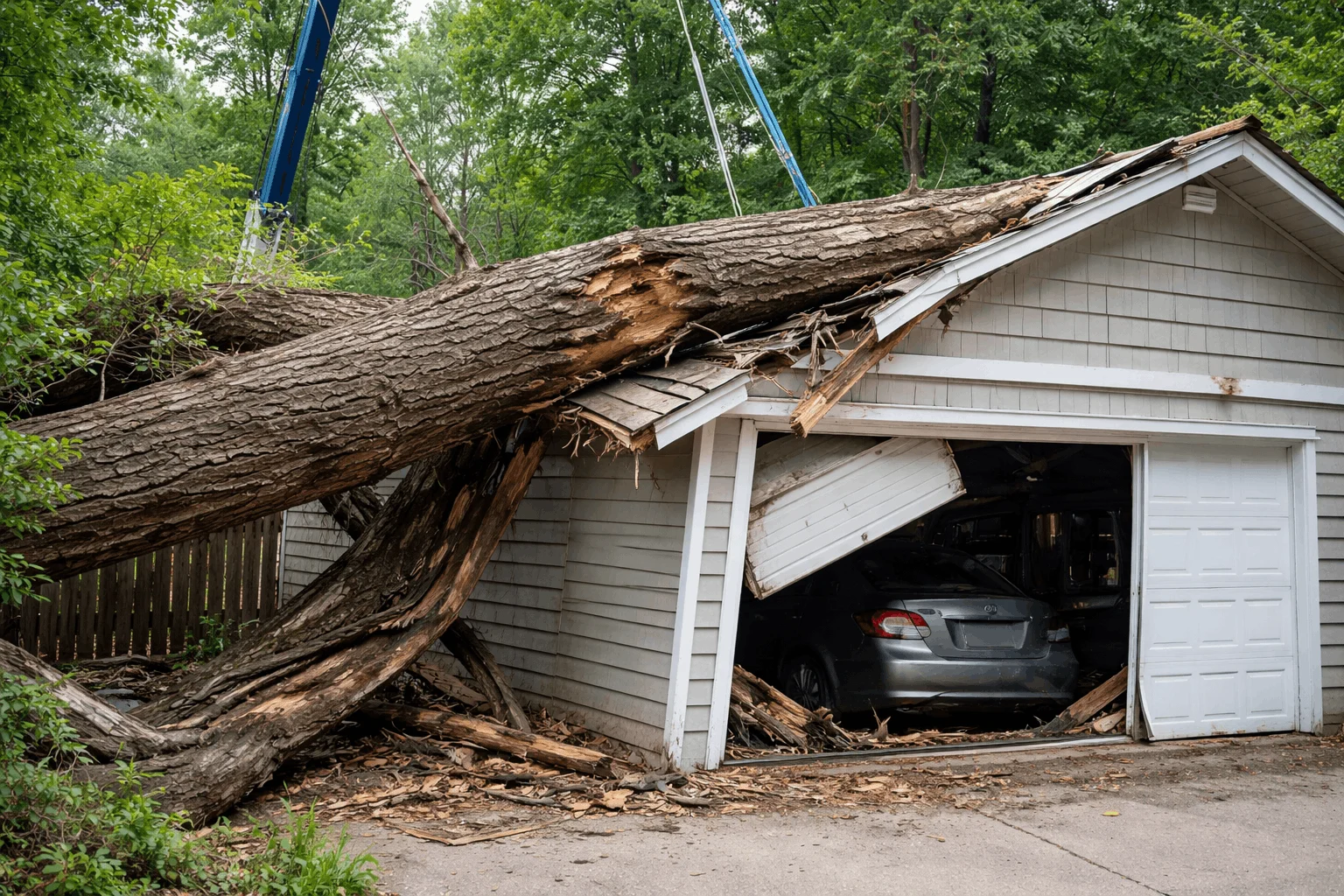
When a tree falls on a garage, most homeowners want to know three things right away: how serious the damage is, how the tree gets removed, and whether the garage can still be saved.
The short answer is that a garage is not always removed the same way as a house. Even though both are structures, garages often respond differently when a tree lands on them. That is why tree on garage removal usually starts with looking at the structure itself, not just the tree.
Some garages hold their shape better than expected. Others become unstable once a roof load is added suddenly. The goal is to remove the tree carefully, reduce added stress on the structure, and leave the site clear for the next step.
If the damage involves the main home instead of the garage, Tree On Me also handles tree on house removal.
Why Garage Tree Removal Has Unique Challenges
A garage may look simple from the outside, but structurally it can be tricky.
Unlike a house, a garage often has a wide open interior. There are usually fewer interior walls helping support the roof. Many garages also have a large door opening across the front, which changes how weight is carried through the structure.
That matters when a tree lands on the roof.
If a heavy trunk or large limb comes down across that open span, the roof system may be carrying weight in a way it was never designed to handle. In some cases, the framing stays mostly in place. In others, parts of the roof or wall system start shifting once the load settles.
There is also the issue of vehicles and storage. A fallen tree on garage structures often means there is a car underneath, blocked access, or debris packed into a smaller area than you would see with a tree on open ground. That affects how crews move, where they cut, and how debris is controlled.
A lot of people also ask whether the garage can still be saved. Sometimes yes. Sometimes no. That depends on where the tree hit, how much weight is sitting on the roof, and what the framing looks like once the tree is off.
Equipment and Access Considerations
Garage jobs are often harder than they first appear because access is not always straightforward.
Some garages sit close to fences, neighboring homes, decks, sheds, or power lines. Others are behind the house or down a narrow driveway. Even when the tree is visible, that does not always mean it is easy to reach.
In tighter setups, the removal plan may involve crane-assisted tree removal. That can help when large sections need to be lifted away cleanly or when ground access is limited. Instead of dragging heavy pieces across a damaged roof, the tree can sometimes be removed more directly and with better control.
Rigging also plays a big role. In residential yards, sections may need to be secured and lowered piece by piece. This helps keep the load controlled while protecting nearby property and containing debris.
That is especially important with a tree through garage roof situation, where broken roofing material, branches, and framing debris may all be concentrated in one area.
The Removal Sequence
Every garage job is a little different, but the process usually follows the same general order.
It begins with an assessment of the tree, the roof load, and the condition of the garage. The crew looks at where the tree is resting, whether the structure is leaning or sagging, and how access will affect the removal.
From there, the structure may need to be stabilized enough for safe work to begin. That does not mean repair work. It means planning the removal around the way the garage is currently holding the load.
Then comes the actual cutting.
In most cases, the tree is removed section by section. Smaller limbs may come off first to reduce weight and improve visibility. Heavier pieces are then cut and either lowered or lifted in a controlled way. The order matters because removing one section can change how the rest of the tree is sitting on the structure.
Once the main weight is off, the remaining debris is cleared from the garage area. That includes trunk wood, branches, roofing debris, and loose material created during impact and removal.
The final step is site cleanup, so the property owner can clearly see the condition of the garage after the tree is gone.
What Happens to the Garage Afterward
Once the tree has been removed, attention shifts to the structure itself.
At that point, the garage may need to be reviewed by the appropriate contractor or structural professional. They can determine what parts of the roof, walls, or framing need repair and whether the structure is still sound.
This is an important distinction. Tree removal comes first. Building repair comes after.
That is why a garage tree removal service is focused on getting the tree off safely and clearing the affected area. Repair decisions are usually made once the load is gone and the damage can be seen more clearly.
Sometimes a garage looks worse than it is. Sometimes it looks stable but has hidden structural damage. That is why it is best not to make assumptions too early, especially before the tree has been fully removed.
If there is damage involving the home as well, Tree On Me’s 24-hour emergency service is available across Montgomery County for structure-related tree removal situations.
Serving Montgomery County
Tree On Me provides tree on garage removal services throughout Montgomery County, MD.
That includes areas such as Rockville, Bethesda, Silver Spring, Gaithersburg, Potomac, Germantown, Wheaton, Kensington, Olney, Takoma Park, Poolesville, and nearby communities.
Whether the issue is a tree fell on garage, a leaning tree threatening the structure, or a fallen tree on garage after storm conditions, the work starts with a careful look at the structure, access, and removal plan.
A garage may not carry the same role as the main house, but when a tree lands on it, the removal still needs to be handled with the structure in mind. That is what makes the process different from ordinary tree work.
Tree On Me focuses on that kind of structural removal across Montgomery County, including situations where careful access, controlled cutting, and debris management all matter from the start.