Emergency tree removal is not the same as scheduled tree work. When a tree has fallen on a structure, is blocking access, or poses an active hazard, the job needs to be approached differently — with an on-site assessment, equipment matched to the specific situation, and a removal sequence designed around the hazards present. This article explains how the process works when you call Tree On Me.
The Call and Initial Assessment
When you contact Tree On Me, we ask questions to understand your situation: what fell, where it landed, what structures or utilities may be affected, and what access is available. This information shapes the initial response — what equipment to bring, how many crew members are needed, and what the likely scope of the job looks like.
On arrival, the crew conducts a site walk before any cutting begins. This covers the full extent of the fallen or hazardous tree, secondary hazards such as utility contacts and unstable ground, and access constraints. The assessment may take several minutes. It is not skipped in the interest of speed — the information it produces directly affects how safely and effectively the job can be done.
Equipment Selection
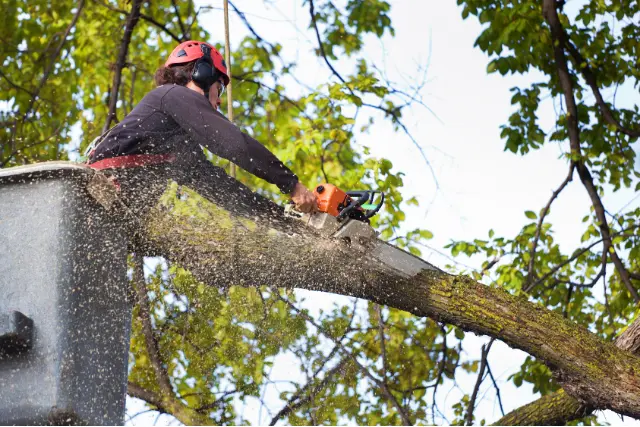
Emergency tree removal uses a range of tools depending on the specifics of the job. Most emergency situations involve some combination of chainsaws for sectioning, ropes and rigging for controlling descent, and hand tools for debris management. Mechanical equipment — skid steers, chippers, trucks — is used for moving and removing material once it has been cut.
Jobs involving trees on structures, trees in tight access situations, or unusually large material may require crane assistance. The crane provides a higher level of control during the lift and placement of heavy sections, and it allows sections to be carried away from a structure horizontally. Tree On Me determines crane need on a job-by-job basis. You can read more about our crane-assisted tree removal approach and when it applies.
The Removal Sequence
The cutting order matters. An experienced crew approaches a fallen or hazardous tree by identifying where the tension and compression are in the wood — which side is under load, which sections will roll or spring when cut, and in what order cuts should be made to release weight safely.
For a tree on a structure, this typically means working from the canopy end inward, removing smaller branches and limbs first, then sectioning the main trunk progressively as each section is cleared from the work zone. Weight is released gradually rather than all at once. Each cut is planned before it is made.
Debris Handling and Site Cleanup
Emergency tree removal includes debris handling as part of the scope. After sections have been cut and removed from the immediate work zone, brush, small branches, and other material are gathered and cleared. Wood sections may be stacked in a designated area for the property owner’s use, or removed from the property — the arrangement depends on the job.
Stump grinding is a separate scope of work. Emergency removal addresses the fallen or hazardous tree — the stump, if any, remains and can be addressed at a subsequent scheduled appointment.
After the Job Is Done
After the tree has been removed and the site cleared, Tree On Me conducts a walkthrough with the property owner. Documentation of the work — a removal summary, before and after photos — can be provided on request.
The next steps typically involve coordinating with other contractors: a roofing contractor if the structure was affected, a structural engineer if there is a question about the building’s integrity, or a landscape contractor for ground restoration. Tree On Me’s scope ends with the removal. Contact Tree On Me for 24-hour emergency tree service throughout Montgomery County, MD.