When hurricane remnants or tropical storm bands move through Maryland, tree damage in Montgomery County can look very different from the usual single-tree problem. It is often not one clean failure in one part of the yard. It can be several damaged trees at once, large limbs spread across the property, and trees that are still standing but no longer structurally sound. In the Mid-Atlantic, direct landfalling hurricanes are rare, but the National Weather Service notes that remnant tropical systems pass through the region more often, bringing heavy rain, flooding, and wind that still create serious tree failures.
For homeowners searching for hurricane tree removal in Montgomery County, the real issue is usually not just the visible mess. It is the combination of saturated soil, compromised roots, broken canopies, and debris spread over roofs, driveways, fences, and yards. That is why hurricane tree damage removal is usually more technical than a routine removal on a dry day with a stable tree.
Hurricane Tree Damage in Montgomery County
Maryland does not need a direct hurricane strike to see widespread tree damage. Remnant tropical storms and post-hurricane weather systems can still bring the kind of rain and wind that weaken root systems and push already stressed trees past their limit. The Baltimore/Washington National Weather Service specifically notes that remnants of tropical storms or hurricanes pass through the Mid-Atlantic more commonly than direct landfalls, and past storms affecting Maryland have produced extensive tree damage, heavy rain, and downed trees.
In Montgomery County, that matters because many properties have mature trees close to homes, garages, fences, and driveways. A storm like this rarely leaves behind one simple cleanup. It may involve one tree uprooted in the back yard, another leaning toward the house, and a third that dropped a heavy limb onto a roof or across a fence line. Tree On Me’s existing storm service pages already reflect that kind of work, including storm-related uprooting, trunk splits, hanging branches, and multi-tree assessments across Montgomery County.
Oak and tulip poplar are also part of the local picture. Oaks are common in Maryland landscapes and can lose large limbs in storm conditions, while University of Maryland Extension has documented tulip poplar storm damage from high winds and heavy rain. On a property with older canopy trees, that can mean several different failure patterns at the same time rather than one uniform problem.
Types of Damage Tree On Me Handles After a Major Storm
After a major wind event, the damage is not always dramatic in the same way. Some trees are fully down. Others are partly failed and more complicated because they are still holding weight and pressure.
Complete uprooting
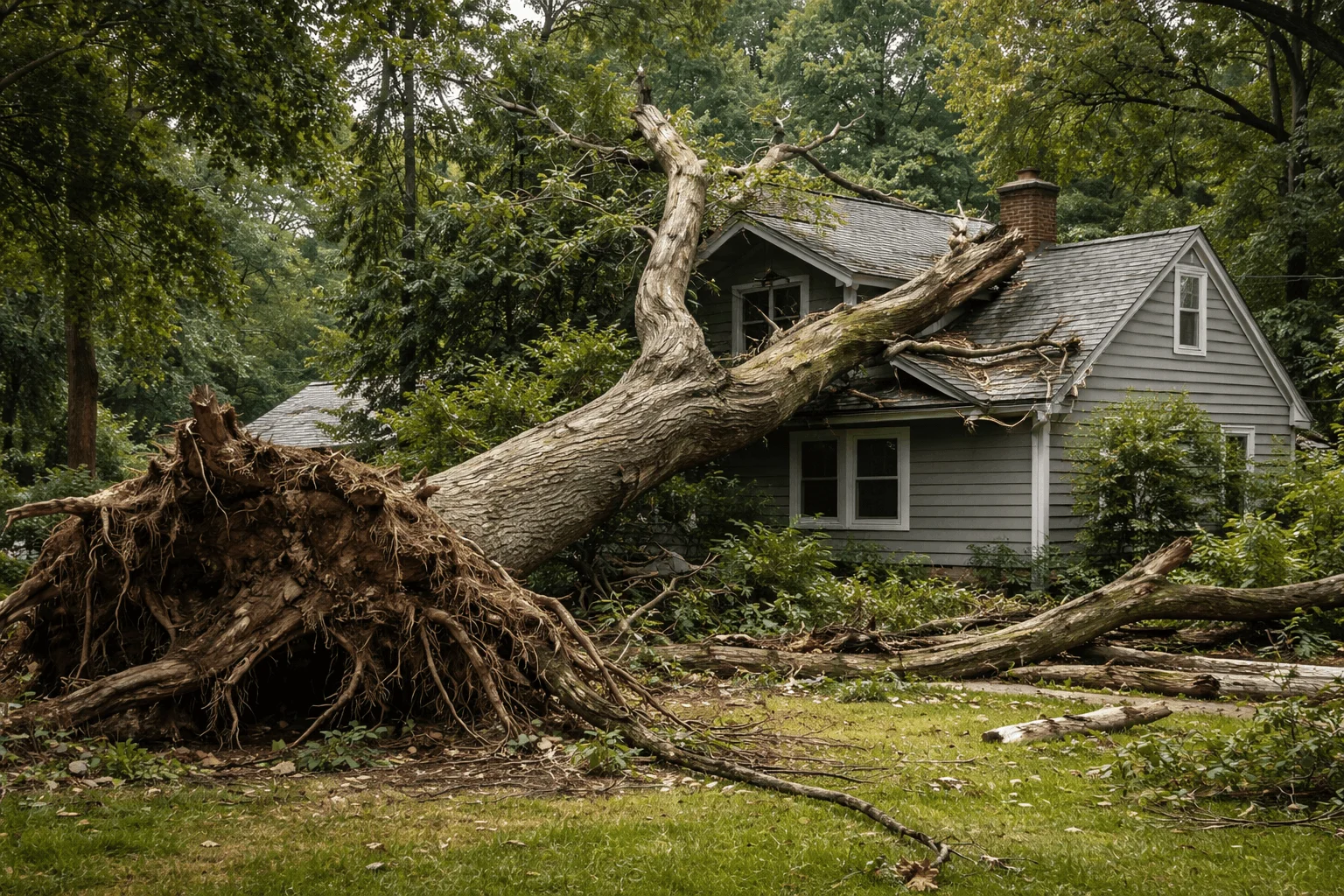
This is one of the most obvious post-storm failures. The trunk may already be on the ground, but the root plate can still be partly attached and unstable. That is one reason uprooted tree removal is its own category of work. The visible fall is only part of the issue. The root ball, the soil void, and the way the trunk is resting all affect how removal should be approached.
Trunk splitting and structural cracking
Some trees stay upright after the storm but split through the trunk or develop major structural cracks. These trees can look “not that bad” from the street, but they may not behave predictably once cutting begins. Wind-loaded stems and partially failed trunks often require a more controlled removal plan than a standard backyard tree job. Tree On Me’s storm damage tree removal service describes this kind of storm-specific assessment and removal work.
Large limb failures on structures
A hurricane-damaged property often has at least one heavy limb on a roof, porch, garage, shed, or fence. In that situation, the limb itself is only part of the problem. The attachment point may be torn, the remaining canopy may still be unstable, and the weight may be distributed in a way that changes as sections are removed.
Leaning trees with compromised roots
A leaning tree after heavy rain is not always a routine pruning decision. If the soil has softened and the root system has already shifted, the lean may be a sign that the tree has lost enough anchoring to fail later. That is especially true when the tree is near a house, driveway, retaining wall, or neighboring property.
Why Post-Hurricane Removal Requires Care
Post-hurricane tree removal is usually more delicate than people expect. Wet soil changes the whole job. A tree that might have been stable enough for a normal removal plan in dry conditions may no longer have dependable root support once the ground is saturated. The National Weather Service and extension sources both point to heavy rain and saturated ground as major factors in storm-related tree failure.
That is why secondary failures are a real concern during cleanup. One tree may already be down, but another nearby tree may have lifted roots, hidden cracking, or weight imbalance that is not obvious until crews start moving debris or unloading pressure from the canopy. A big part of hurricane damage tree service is reading what is still under tension, what may shift, and what order the work should happen in.
Standard methods also do not always apply. With compromised root systems, partial failures, and trees resting on structures, removal may require rigging, sectional dismantling, or crane-supported lifts instead of a simpler cut-and-drop approach. Tree On Me’s storm pages describe that kind of adapted process, including controlled removal, rigging, and equipment planning for damaged trees in Montgomery County.
What the Removal Process Looks Like
When several trees are affected on one property, the process usually starts with triage rather than immediate all-at-once cleanup.
Priority assessment across multiple trees
Crews first sort the site by condition and consequence. A tree on a structure is different from a tree down in open lawn. A leaning tree near a driveway is different from loose brush in the back corner of the lot. On storm jobs, the first step is often deciding what creates the highest risk, what affects access, and what can wait until the main hazards are addressed. Tree On Me’s storm service content describes this as a hazard-based, multi-tree prioritization process.
Equipment deployment
Once the sequence is clear, the removal method can be matched to the job. That may involve climbing and rigging, sectional lowering, loader support, or crane work for larger pieces over structures or tight access areas. Storm cleanup at this scale is less about speed for its own sake and more about using the right setup for unstable trees and heavy debris.
Debris handling at scale
This is one of the biggest differences after a hurricane-type storm. The job may include multiple brush piles, broken trunks, scattered limbs, torn root balls, and debris spread across several parts of the property. Cleanup needs to be organized so the site can be cleared without creating new access problems or interfering with the removal of the remaining damaged trees.
In other words, post-hurricane tree removal is often a sequence: assess, prioritize, remove in a controlled order, then clear and haul material in phases. For situations that need after-hours dispatch because of a true tree emergency, Tree On Me also states that it provides 24-hour emergency response across Montgomery County.
Serving Montgomery County After a Storm
Tree On Me presents itself as a Montgomery County-only service and lists coverage across communities including Rockville, Bethesda, Silver Spring, Gaithersburg, Potomac, Germantown, Wheaton, and Kensington. The company also states that it offers 24-hour emergency response throughout the county and handles storm damage, trees on structures, and other weather-related tree failures.
That local focus matters after a major storm because cleanup in Montgomery County is not one-size-fits-all. Older neighborhoods with mature canopy trees can have layered damage across multiple properties. Some streets have tighter access. Some lots have heavy tree cover close to homes and detached structures. Some properties deal with saturated soil and partial failures more than total collapse. A company set up for hurricane tree damage removal in this county needs to be able to work through those conditions methodically, not treat every storm job like the same standard removal.