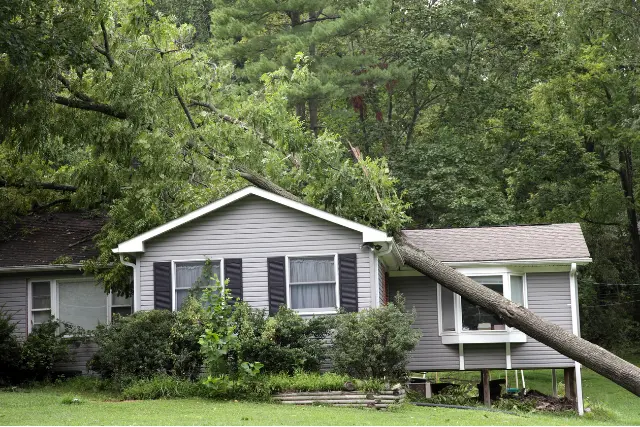
Most trees that fall on homes do so because of conditions that were visible beforehand — conditions that, if identified early, allow for a planned removal rather than an emergency one. This article describes the warning signs that tree professionals look for when evaluating whether a tree poses a risk to a structure. Tree On Me provides hazardous tree assessment and tree on house removal services throughout Montgomery County, MD.
Why Trees Fail — The Basics
Tree failures result from a failure in the structural system that keeps the tree standing: the roots, the trunk, or the attachment of major branches. Root failures occur when the root system can no longer anchor the tree — due to decay, construction damage, shallow root development, or soil disturbance. Trunk failures occur when structural wood is weakened by decay, cracks, or co-dominant stem geometry. Branch failures occur when large limbs lose their attachment integrity, often due to included bark or decay at the branch union.
Montgomery County’s tree canopy consists largely of large deciduous species — oaks, tulip poplars, sweetgums, and maples — that can grow to substantial size over decades. When these trees develop structural problems, the scale of potential failure is correspondingly large.
Warning Signs in the Crown
The crown is often the first place visible signs of stress appear. Dead or dying branches — limbs with no leaves during the growing season, or limbs with dead, dry bark — indicate that the tree is losing its ability to sustain parts of its canopy. Crown dieback, where large sections fail to leaf out in spring, suggests more systemic stress.
Hanging broken limbs — called widow-makers in arboriculture — are an immediate concern. A large broken limb suspended in the canopy can fall at any time without warning. If you see a significant broken limb in the crown of a tree near your house, contact a tree professional.
An unusual lean that appears to have developed recently — particularly a lean toward a structure — warrants a professional assessment.
Warning Signs at the Trunk
The trunk is the column that transfers all load from the canopy to the roots. Signs of structural compromise in the trunk are serious indicators of failure risk.
Cracks along the length of the trunk or at a branch union suggest that the wood has already partially separated. Cavities — hollow sections in the trunk — indicate decay that has progressed to the point of removing structural wood. Fungal growth on the trunk, particularly shelf fungi (bracket fungi), is one of the clearest indicators of internal decay: their presence means the decay process is well advanced, even if the exterior of the trunk looks intact.
Cankers, areas of dead bark that often ooze sap or show discoloration, suggest disease or pest activity. Bark that is separating from the trunk or showing unusual vertical cracks should be noted.
Warning Signs at the Base and Roots
Root problems are harder to see than crown or trunk issues, but several surface indicators can point to them. Soil heaving on the side of the tree opposite the lean suggests the root ball is starting to lift — one of the strongest indicators that a tree is losing its anchor and may uproot.
Mushroom growth at the base of a tree indicates root decay. Construction within the drip line — where grade has been changed, soil compacted, or roots cut — can cause progressive decline that takes years to manifest visibly. Erosion that has exposed the major structural roots, removing the soil support they depend on, is also a concern.
What to Do If You Notice Signs
Do not attempt to remove a tree showing these signs yourself. A tree with structural compromise can fail in unexpected ways during cutting, making DIY removal significantly more dangerous than routine tree work.
Contact Tree On Me to schedule a leaning tree removal assessment or a hazardous tree evaluation. We will describe what we observe and explain the recommended approach. If the situation appears to present immediate risk, it can be addressed as an emergency tree removal situation.