
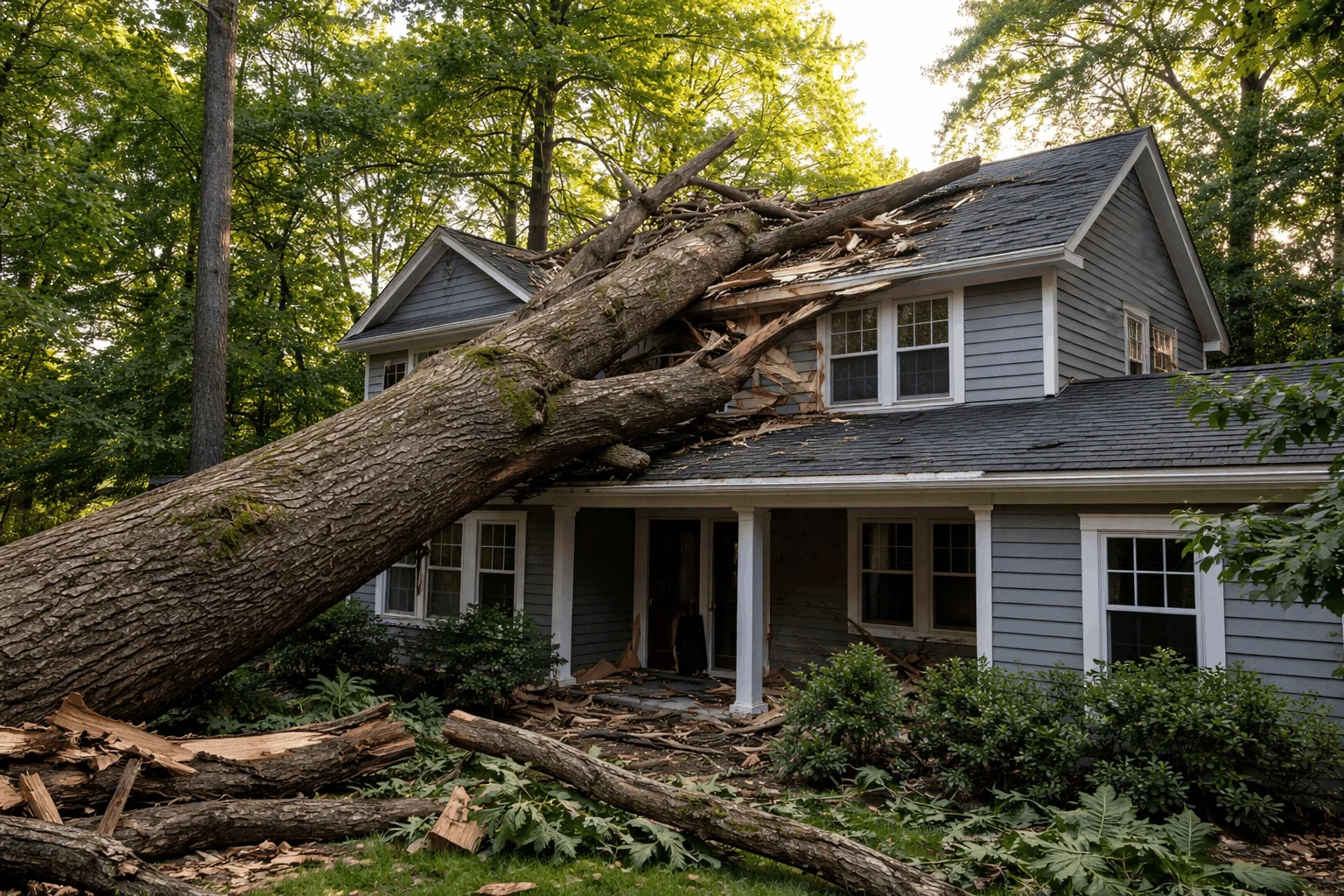
If a tree just hit your home, do not try to figure out everything at once. Handle it one step at a time. Safety comes first, then the right calls, then documentation, then cleanup and repair planning. If a tree fell on your roof, the safest approach is usually to assume the damaged area is not stable until a qualified professional says it is.
Step 1: Ensure Everyone Is Safe First
The first thing to do is get everyone away from the part of the house that was hit. That includes anyone upstairs, in the attic area, or in rooms directly under the impact. If you have pets, get them out too. Do a quick head count and make sure everyone is accounted for.
Even when the damage looks “not that bad” from outside, a tree can put a lot of weight on the roof framing, ceiling, or walls. Sometimes the structure holds for the moment, but that does not mean it is safe to stay under it.
Start here
- Move everyone out of the affected area
- Stay away from rooms with sagging ceilings, cracked walls, or fallen debris
- Watch for broken glass, nails, and unstable branches
- Do not go back in just to grab personal items
If part of the home looks shifted, bowed, or partially collapsed, it is better to stay out. A lot of homeowners make the mistake of stepping back inside because they want to take a quick look or save something before it gets wet. That is understandable, but it is not worth the risk.
If you can safely stand outside and see the tree resting across the roofline or pushing into the structure, leave it alone. Do not try cutting small limbs off yourself. Do not pull branches away from siding or gutters. Once the tree is on the house, the situation changes. The weight may be holding things in place in ways that are not obvious from the ground.
Step 2: Call Emergency Services If Needed
Some situations need more than a tree crew. If there is an immediate threat to people or the property, call 911.
Call 911 if you notice:
- anyone is injured
- someone is trapped inside
- you smell gas
- power lines are involved
- there are sparks, smoke, or fire
- part of the house looks like it may give way
- an exit is blocked and people cannot get out safely
If you think there may be a gas issue, leave the area and stay out. Do not flip light switches, do not use appliances, and do not assume the smell will go away on its own. If electrical wires are involved, keep your distance from the tree and the ground around it. Downed or damaged lines are not something to guess about.
If none of those hazards are present, then you can move into the next steps calmly. That usually means documenting what happened, then calling a qualified tree company that handles structural impacts. Tree On Me offers 24-hour emergency tree service in Montgomery County, MD for situations where a tree has come down onto a house or roof.
Step 3: Document the Damage
Once everyone is safe and there is no active hazard stopping you from doing so, document the damage thoroughly. This record will be useful for coordinating with contractors and as a personal record of the incident.
You do not need perfect photos. You just want a clear record of what happened and what the property looked like before anything gets moved.
What to capture
- wide shots of the house from the front, back, and sides
- where the tree is resting on the home
- any holes in the roof or broken sections of the structure
- interior ceiling damage, wall cracks, water entry, and broken windows
- damaged gutters, siding, fences, or driveway areas nearby
- any blocked access points around the home
A short video can help too, especially if it shows the angle of the tree and how it is sitting on the structure. It is also smart to jot down a few notes while the details are fresh. Write down the time it happened if you know it, which part of the house was hit, what you noticed right away, and whether rain or debris is getting inside.
The key here is to document from a safe spot. Do not climb onto the roof. Do not stand under hanging limbs to get a better angle. Do not step into a room with a bowed ceiling just because you want one more photo.
Coverage for tree damage depends on your individual policy and insurer approval. Contact your insurance company directly.
Step 4: Contact a Professional Tree Removal Service
After safety and documentation, the next step is to call a professional tree company that knows how to handle a tree on a structure. This is not like removing a tree from the backyard after it falls on open ground. Once it is on a house, the tree has to be assessed and removed carefully so the damage is not made worse during the process.
That is why tree removal usually comes before roof repair. A roofer cannot properly work under the weight of a tree, and in many cases the full extent of the damage is not even visible until the tree is off the house.
What to expect when you call
The company will usually want a quick overview of the situation, such as:
- your address
- whether anyone is hurt
- whether utilities may be involved
- where the tree landed
- whether the home is still safe to occupy
- whether access to the property is blocked
They may also ask for a few photos if you can send them safely from outside. That helps them understand what kind of setup may be needed. Some jobs can be handled with a standard crew. Others may require a different removal approach depending on how the trunk and limbs are sitting across the structure.
If the tree is directly on the house, this is where a dedicated tree on house removal service matters. It is not just about cutting wood. It is about removing weight from the structure in a controlled way.
Step 5: Coordinate Contractors
Once the tree removal side is being handled, the next part is getting the repair sequence in the right order. This saves time, avoids confusion, and helps keep one contractor from showing up before the site is ready for them.
The usual order is pretty simple. First, the tree gets removed. After that, the structure can be looked at properly. Then roofing and other repair work can move forward based on what is actually damaged.
A practical order to follow
1) Tree removal first
This clears the load off the house and makes the site safer to inspect.
2) Structural assessment next
If framing, ceilings, walls, or support areas were affected, those need to be looked at before permanent repairs begin.
3) Roofing and exterior repair after that
Once the tree is off and the structure has been checked, roofing and exterior work can be scheduled in a more informed way.
A lot of homeowners feel pressure to call everyone at once. You can, but it helps to think in order rather than all at the same time. The tree has to come off first. That part tends to shape everything that happens after.
It also helps to keep one running note on your phone or in a notebook with names, phone numbers, visit times, and what each contractor says. When you are dealing with a stressful property issue, even simple details can get mixed up fast.
If you are standing there wondering what to do when a tree falls on your house, the answer is not to solve the whole thing in the first ten minutes. Just work the steps. Get everyone safe. Call emergency services if needed. Document the damage from a safe location. Bring in the right tree professionals. Then coordinate repairs in the proper order.
That keeps the situation more manageable, and more importantly, it helps you avoid making a bad situation harder than it already is.