
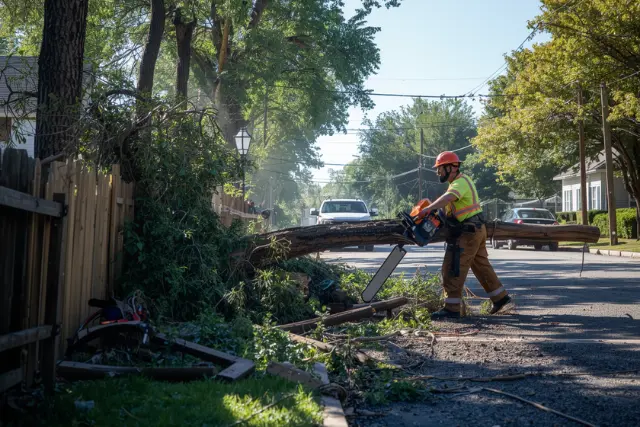
The duration of an emergency tree removal job varies considerably depending on the specifics of the situation, including how emergency tree removal works. There is no single answer that applies across all jobs — and any company that provides a firm timeline before seeing the site is estimating based on limited information. This article describes the factors that affect how long removal takes, so you know what to expect when you contact Tree On Me.
Why Emergency Tree Removal Timelines Vary
No two tree removal situations are the same. The size of the tree, how and where it fell, what structures or infrastructure it has affected, how accessible the site is to equipment, and how much debris needs to be managed all affect the time required. A small tree that has fallen across an open driveway with no structural contact may be cleared in a couple of hours. A large mature oak that has come through the roof of a two-story home, requiring crane assisted tree removal and careful section-by-section removal to protect the structure, is a different scope entirely.
Post-storm situations involving multiple fallen or damaged trees add further complexity. Assessing, sequencing, and clearing multiple trees takes longer than a single-tree removal — and the priority assessment that determines which situation to address first is itself part of the work.
Factors That Extend a Job
Several factors regularly extend the time required for emergency tree removal. Crane requirement is one of the most significant — crane setup, positioning, and the careful sequenced work involved in crane-assisted tree removal add time relative to a standard ground-crew operation.
Tight access — a yard surrounded by fencing with a narrow gate, a lot where equipment cannot get close to the tree — forces the crew to work with smaller sections and more manual effort, which takes longer. Proximity to utility lines, where the tree is in contact with overhead electrical infrastructure, requires coordination with the utility provider before work can proceed. Very large trees with heavy sections require more careful handling at each step. Multiple affected areas on a single property extend the total scope of the work.
Factors That Shorten a Job
Jobs that proceed quickly typically involve smaller trees, open access for equipment, and no structural complications. A tree that has fallen away from structures, where the crew can section it freely and a chipper can process brush efficiently, is a relatively fast job. A dead tree removal scheduled in advance — where no emergency access is required and the crew can plan every step — is typically faster than an emergency response under uncertain conditions.
What to Expect When Tree On Me Arrives
When Tree On Me arrives on site, the first step is a site walk to assess the full situation before any cutting begins. This assessment may take several minutes, but it shapes everything that follows. We will explain the general approach before beginning and communicate significant updates if conditions change during the job.
We do not provide fixed time guarantees. The duration of the work is determined by the conditions we find. What we can tell you is that the crew works methodically, and that debris cleanup is included in the removal scope — the site will be clear when we leave.
After the Work Is Complete
When the removal is finished, Tree On Me completes a site walkthrough with the property owner. Documentation of the work can be provided on request. If follow-up work is needed — stump grinding, additional cleanup, or coordination with other contractors — we discuss that at the walkthrough. Contact Tree On Me for 24-hour emergency tree service throughout Montgomery County, MD.