A hazardous tree assessment is a structured evaluation of a tree’s structural condition, its proximity to targets such as structures and utilities, and its likelihood of failure. Assessments are conducted when a property owner observes signs of potential concern — leaning, decay indicators, dead branches — and wants to understand the level of risk before deciding on a course of action. Tree On Me provides hazardous tree assessment and removal throughout Montgomery County, MD.
What Is a Hazardous Tree Assessment
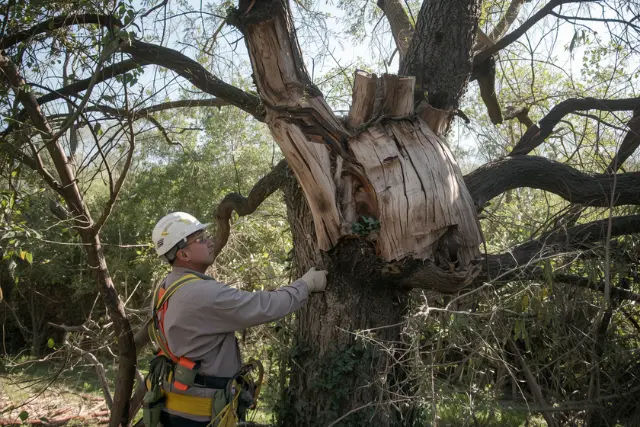
A hazardous tree assessment examines the warning signs a tree may fall: the condition of the root zone, the structural integrity of the trunk, the health and attachment of major branches, and the relationship between the tree and the targets it could reach if it failed. The goal is not simply to determine whether a tree is dangerous — it is to understand what specific conditions are present and what each one means for the tree’s risk profile.
An assessment should be conducted by someone with working knowledge of decay organisms, root failure patterns, structural wood mechanics, and the indicators that commonly precede catastrophic failures.
What Tree On Me Evaluates During an Assessment
During a Tree On Me site assessment, we examine the crown for dead or dying branches, crown dieback, and unusual lean. We examine the trunk for cracks, cavities, fungal growth, co-dominant stem geometry, and bark conditions that indicate disease or pest activity. We examine the root zone for soil heaving, root exposure, construction damage, and mushroom growth at the base.
We also evaluate context: how large a target the tree could reach in a failure, in what direction the tree is most likely to fail, and whether the target is a structure, a utility line, a vehicle, or a low-use area. The combination of structural condition and target proximity determines the risk profile and whether leaning tree removal service is needed.
Common Findings and What They Mean
Bracket fungi on the trunk are among the most serious findings. Their presence indicates that internal wood decay — caused by fungi consuming the cellulose and lignin in the wood — has progressed significantly. The exterior of the trunk may look intact while the structural core is compromised.
Co-dominant stems, where two trunks of roughly equal size share a single attachment point, are a structural vulnerability. When included bark is present at the union — bark embedded in the attachment rather than clean wood-to-wood contact — the attachment is weaker than it appears and susceptible to splitting under wind load.
Soil heaving on one side of the tree, where the ground is visibly lifting in response to root movement, is often one of the last visible signs before uprooting occurs.
After the Assessment: Your Options
Not every assessment results in a recommendation for removal. Trees that show minor stress indicators, no immediate lean toward a structure, and no evidence of significant decay may warrant monitoring rather than removal. Tree On Me presents findings factually and explains what each indicator means — we do not recommend removal unless the structural evidence supports it.
Where removal is warranted, we discuss the approach and scope. Where removal is not urgent, we describe what to watch for and when reassessment should be considered. Cabling and bracing — supplemental structural support for co-dominant stems or weak attachments — may be appropriate in some cases and can be addressed by a certified arborist.
Serving Montgomery County
Tree On Me provides hazardous tree assessment and emergency tree response throughout Montgomery County. We serve Rockville, Bethesda, Silver Spring, Potomac, Gaithersburg, Olney, and surrounding communities. Contact Tree On Me to schedule an assessment or discuss a leaning tree removal situation.