If a tree fell on your roof in Rockville, MD, the situation can go from normal to stressful very fast. One minute everything is fine, and the next you are hearing a crash, seeing debris, or wondering whether it is still safe to be inside. In that moment, most homeowners are not thinking about cleanup. They just want to know what to do first.
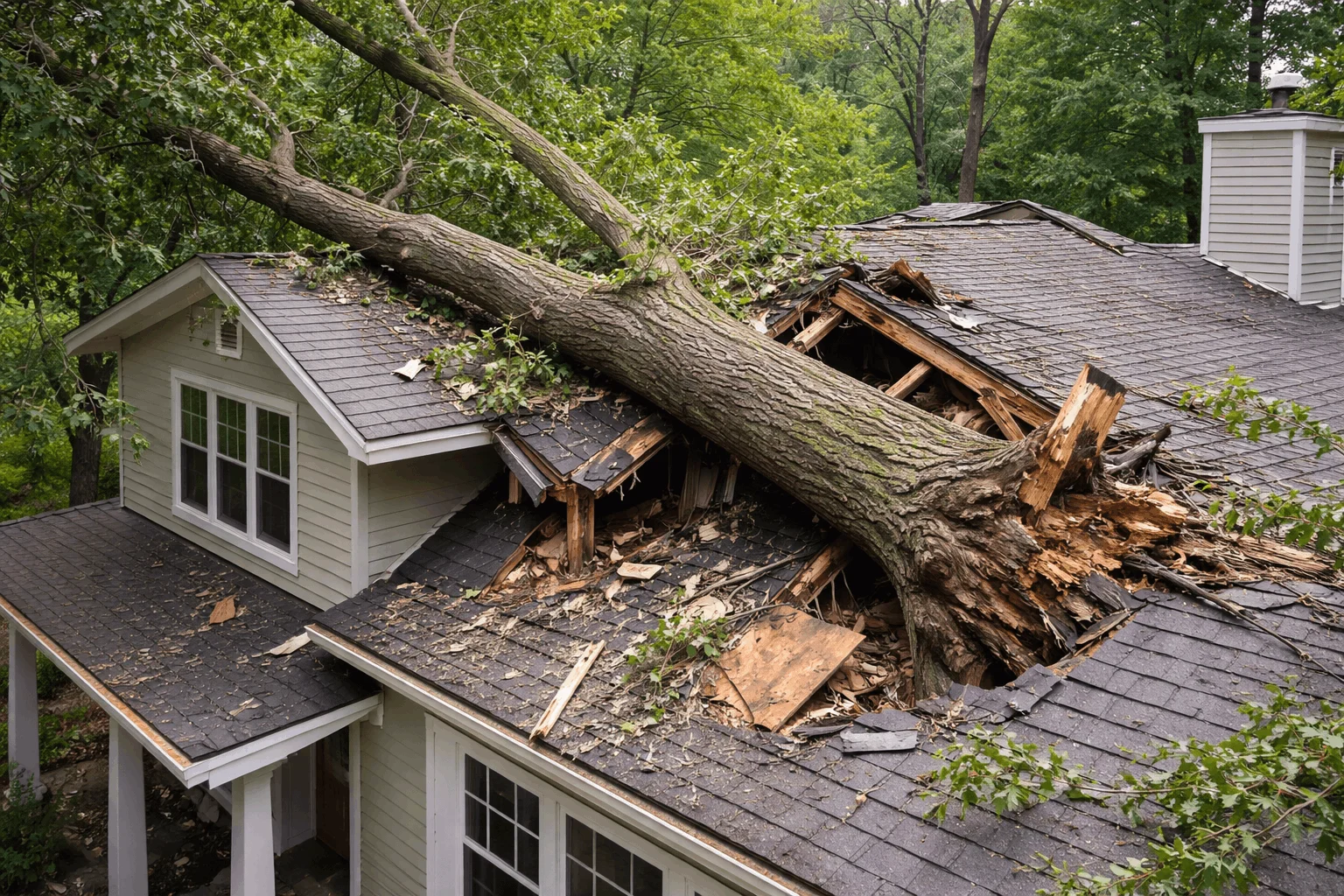
That is a reasonable question, especially in Montgomery County where mature oak and poplar trees are a common part of the landscape. They give neighborhoods a lot of shade and character, but during strong seasonal wind events, including nor’easters, large limbs and full trees can come down hard enough to damage a roof, ceiling, or part of the structure. When that happens, it is not just a debris problem. A tree sitting on a house may still be putting weight on the building, which is why removal usually needs to happen before repair work starts.
This blog walks through the first steps after impact, what may make the house unsafe, and how roof removal is usually handled.
Your First Priorities After a Tree Hits Your Roof
Start with safety. If the roof is visibly sagging, part of the ceiling has come down, walls look shifted, power lines are involved, or there is any sign the structure may keep failing, get out and stay out. If there is concern about structural collapse, call emergency services. It is better to treat the home as unsafe than to assume the damage is limited just because only one area is visible from the ground.
Even when the impact looks smaller than expected, it is still smart to be cautious. A tree can strike one section of the roof but transfer weight or stress into other parts of the framing. You may not see that from inside the house. Rooms directly below the impact area are not the place to stand and assess what happened. The same goes for going into the attic, climbing onto the roof, or walking under hanging limbs.
A lot of people naturally want to start moving branches right away. That urge makes sense, but it can make the situation worse. What looks like loose debris may actually be bracing another section in place. If something is cut or pulled in the wrong order, the tree can shift and add more pressure to the damaged structure. That is one reason this kind of job is very different from ordinary yard cleanup.
If you can do it safely from a distance, take a few photos of the damage and the area around the house. After that, the focus should be on getting the site looked at properly and keeping people clear of the impact zone until the situation is assessed.
Why Roof Tree Removal Requires a Specialist
A tree lying in the yard is one thing. A tree on a roof is something else entirely.
Once a tree lands on a house, it becomes part of a structural problem. The trunk or large limb may be resting on rafters, pushing into the roof deck, hanging over an edge, or partially wedged into the home. In some cases, the tree is doing damage simply by being there. In other cases, it is also holding damaged parts of the structure in a temporary position. That is why a tree through roof situation needs a more controlled approach than standard removal.
The biggest issue is load. The weight of the tree is often still being carried by the house, and that load can change the second pieces start coming off. A section that looks stable from the driveway may actually be cracked, suspended, or under tension. If it is cut without a plan, it can roll, drop, or shift in a way that opens the roof further or causes more collapse.
That is why roof work often involves rigging, controlled lifting, or removal in small sections rather than simple cutting. In some cases, a crane is the safer option because it allows heavy sections to be lifted away from the structure instead of being broken apart over it. If you are dealing with a tree on a home rather than a tree in open space, Tree On Me handles this as a tree on house removal service rather than a routine cleanup job.
This kind of work is really about control. Not speed for the sake of speed. Not cutting whatever is easiest to reach first. Just careful decision-making based on how the tree landed and how the house is carrying that weight.
How Tree On Me Approaches Roof Removal
When Tree On Me responds to a tree damage roof Maryland situation, the first step is assessment. Before anyone starts cutting, the crew needs to look at how the tree is sitting on the structure, where the pressure points are, whether any sections are hanging or under tension, and whether there are added hazards nearby. Every roof impact is a little different, so the removal plan needs to match the actual conditions on site.
From there, the next decision is equipment. Some jobs can be handled with rigging and a controlled cutting sequence. Others may call for crane support, especially when a large trunk or major limb is resting across the roof in a way that makes manual dismantling less appropriate. The size of the tree, the angle of impact, the amount of suspended weight, and access around the property all affect how the job is approached.
Then comes the part most homeowners never see until they are in this situation: the cutting sequence matters a lot. Roof removal is not just about taking pieces off until the tree is gone. Each cut changes the load on the structure. Smaller limbs may need to be removed first to expose where the main weight is sitting. Suspended sections may need to be secured before cutting begins. Larger pieces are often removed gradually so the pressure on the roof changes in a more controlled way.
That is also why emergency tree removal roof work is not something homeowners should try to handle themselves. Even a section that looks manageable from the ground can behave very differently once tension is released.
After the tree is off the house, the remaining debris can be cleared from the property so the next phase of work can move forward. If you are looking for the service side of that process, Tree On Me provides 24-hour emergency tree service in Rockville and across Montgomery County.
Working with Other Contractors
One thing that helps to understand early is that removal and repair are usually two separate steps.
If the tree is still on the roof, a roofer generally cannot begin normal repair work yet. The structure first needs to be cleared so the damage can be seen more accurately and so other contractors are not working beneath an active load. That is why the tree removal portion usually comes first. Once the tree is off and debris has been cleared, the roof and structure can be evaluated for the work that comes next.
That process tends to go more smoothly when everyone is working in the right order. The removal crew addresses the tree hazard. After that, a roofer or other contractor can assess exposed damage, temporary protection needs, and the repair scope. When a tree has gone through the roof or landed across multiple sections of the home, it often takes coordination rather than everyone trying to work at once.
This is also the point where many homeowners start asking about insurance. Use only this language: Coverage for tree damage depends on your individual policy and insurer approval. Contact your insurance company directly.
It also helps to keep photos, notes, and contractor communication in one place from the beginning. That will not change the damage itself, but it can make the next steps easier to follow once the house is clear enough for repairs to be planned.
Serving Rockville and Montgomery County
Tree On Me serves Rockville and communities throughout Montgomery County, MD. That local focus matters because tree impacts on homes are rarely one-size-fits-all. Lot access, tree size, roof layout, neighboring structures, and the way the tree came down all affect how removal should be handled.
In this area, homeowners deal with mature canopy that can include large oak and poplar trees, and after seasonal wind events, those trees can create complicated situations when they come down onto a structure. A roof impact is not the kind of job that should be treated like ordinary debris hauling. It calls for a measured approach, the right equipment for the situation, and clear sequencing before repair work starts.
If a tree fell on your roof in Rockville or elsewhere in Montgomery County, the safest next move is usually to keep people away from the impact area, avoid trying to cut or move anything on your own, and have the situation assessed before roof repairs begin. For homeowners dealing with this exact problem, Tree On Me provides local help for tree-on-structure situations throughout the county. You can also review what to do when a tree falls on your house for additional guidance before the next steps are arranged.