
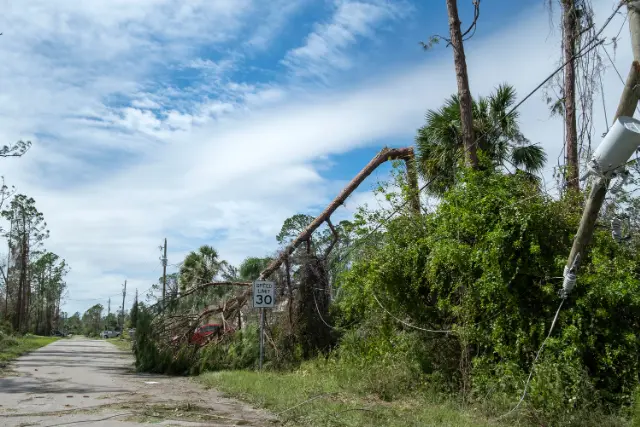
Wind is one of the most common causes of tree damage in Montgomery County. High-wind events produce a spectrum of damage — from broken limbs and cracked co-dominant stems to fully uprooted trees — and not all of it presents the same urgency. Tree On Me handles wind-damaged tree removal for residential and commercial properties throughout Montgomery County, MD.
How Wind Damages Trees
Wind loading applies force to a tree laterally — pushing the crown and applying torque to the trunk and root system. Under normal conditions, a healthy tree flexes under this force and returns to position. Problems develop when the load exceeds the structural capacity of a weakened component: a decayed union, a co-dominant stem with included bark, a root system already compromised by soil saturation or construction damage.
Large limbs in the upper crown are particularly vulnerable to wind failure because they have the highest moment arm from the base — wind force at the tip of a long branch creates significant stress at the attachment point. Montgomery County’s large oaks and tulip poplars frequently produce major limb failures during high-wind events. Hanging broken limbs — widow-makers — are a common result. A limb that has broken but remains suspended in the canopy can drop at any time without further wind force.
Types of Wind Damage Tree On Me Handles
Wind damage takes several forms that Tree On Me handles on a regular basis. Large broken limbs that have landed on structures require the same structural removal approach as any tree on a building — careful load assessment and progressive weight release during cutting. Split trunks, where a co-dominant stem has partially or fully separated at the union, require rigging to control the movement of the separated portion during removal.
Completely fallen wind-thrown trees are handled with the appropriate uprooted or fallen tree approach depending on the specifics. Trees that are leaning with newly loosened roots — not fully down but no longer firmly anchored — present an active hazard and are treated accordingly.
When Wind Damage Is an Emergency
Wind damage constitutes an emergency when the failed component is in contact with or poses a direct structural threat to a building, utility line, or area of regular use. A large limb resting on a roof, a split trunk leaning against a structure, and an uprooted tree that has landed on a garage are emergency situations that require immediate professional response.
Utility contact is always an emergency consideration. A fallen tree in contact with overhead power lines or that has pulled lines down needs to be reported to the utility company. Tree On Me identifies utility contacts as part of the initial assessment and coordinates accordingly.
When Wind Damage Can Be Scheduled
Wind damage that does not involve structural contact or active hazard does not always require an emergency response. A broken limb that has fallen in an open area away from structures, or a tree that has lost branches without landing on anything — these situations can often be scheduled as routine removal rather than emergency response.
Our Emergency vs. Non-Emergency Tree Situations page describes this distinction in more detail. Tree On Me can help you assess where your situation falls on this spectrum.
Serving Montgomery County
Tree On Me provides storm damage tree removal and wind damage removal throughout Montgomery County, including Rockville, Bethesda, Silver Spring, Potomac, Gaithersburg, Germantown, and all surrounding communities. Contact Tree On Me to describe your wind damage situation and arrange service.
Coverage for tree damage depends on your individual policy and insurer approval. Contact your insurance company directly.